
Diagram depicting the anatomy of a wooden deck
- Fundamental Foundation

- Jun 23
- 3 min read
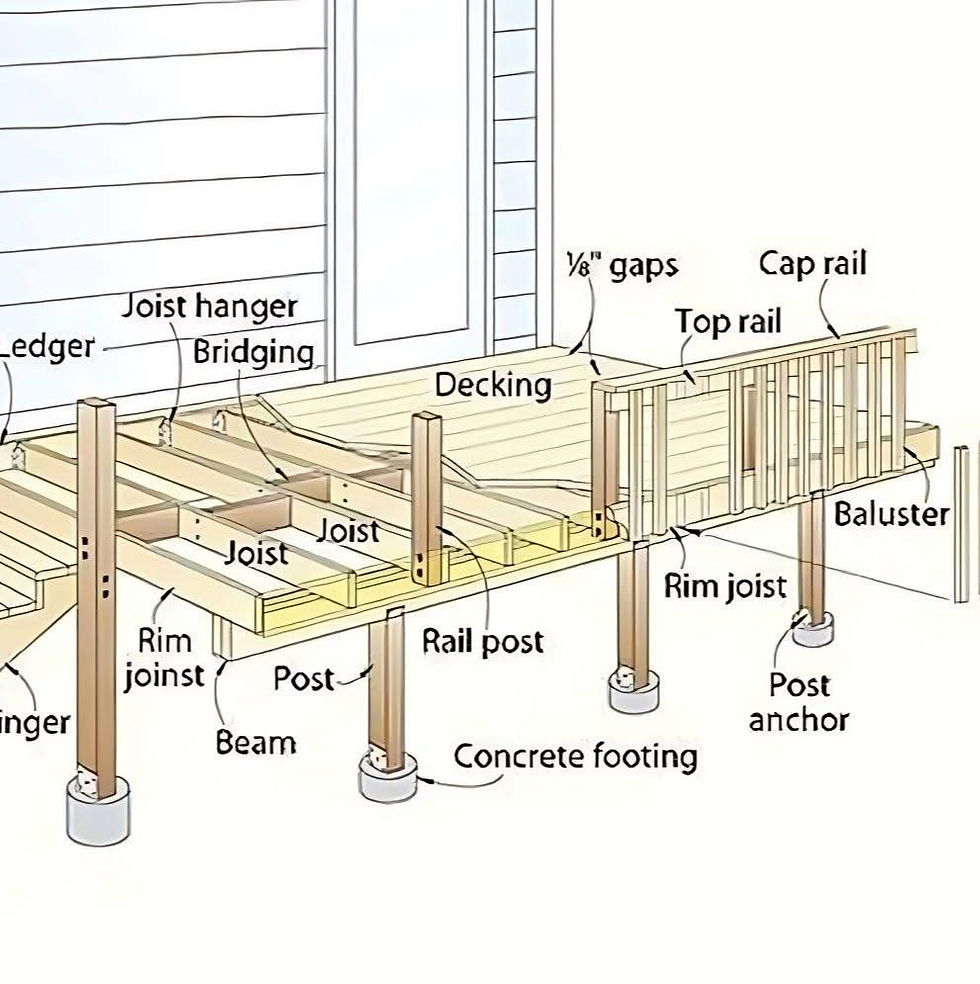
a technical illustration or diagram depicting the anatomy of a wooden deck. It shows the various structural components that come together to form a deck, often attached to a house. The image seems intended for educational or instructional purposes, guiding someone through the construction or understanding of deck building.
Detailed Breakdown of Visible Elements:
1. House (Background):
* On the left is a section of a building's wall, likely the side of a house, with horizontal siding panels.
* To the right is what looks like a glass door or a large window, implying that the deck is an extension of the home's living space.
2. Deck Components:
* Ledger Board: Attached directly to the house's wall, it provides primary support for one end of the deck's joists.
* Joist Hangers: Metal connectors used to attach the joists to the ledger board.
* Joists: Horizontal beams that run parallel to each other, supporting the decking.
* Bridging: These provide lateral support for the joists, preventing them from twisting or buckling.
* Rim Joist: The outer-most joist which is perpendicular to the joists.
* Decking: The surface boards of the deck, creating the walking area. Small 1/8" gaps between each of the decking boards are illustrated.
* Posts: Vertical supports that hold up the beams, typically made of treated wood.
* Beams: Horizontal members supported by the posts, which carry the weight of the joists and decking.
* Concrete Footings: Concrete bases in the ground that support the posts, preventing them from sinking and providing stability.
* Post Anchors: Metal brackets that connect the posts to the concrete footings.
* Rail Posts: Vertical posts that are part of the deck railing system.
* Top Rail: Horizontal rail that sits atop the vertical balusters.
* Cap Rail: An additional rail that sits on top of the top rail, providing a finished appearance.
* Balusters: Vertical spindles or posts that fill the space between the top and bottom rails.
* Stringer: Part of the staircase or stairs leading down from the deck.
Text and Annotations:
The image is heavily annotated with labels that identify each component of the deck structure. These labels are clear and point directly to the corresponding parts, making the diagram user-friendly. The text is plain and functional, fitting the instructional purpose of the image.
Context and Purpose:
This image is likely from a DIY guide, construction manual, or architectural plan. Its primary goal is to visually communicate the construction details and structural relationships of a typical wooden deck.
Emotion and Tone:
The image itself is devoid of strong emotion. Its purpose is informative and objective. It fosters a sense of empowerment for someone looking to build or understand the construction of a deck.
Significant Elements and Considerations:
* Perspective: The drawing uses a perspective that allows viewers to see the interconnectedness of the different structural elements.
* Clarity: The use of labels, clear lines, and different shading helps to distinguish each component.
* Detail: The diagram shows details such as the joist hangers, concrete footings, and even the gaps between decking boards, suggesting thoroughness.
In summary, this image serves as an educational visual, methodically illustrating the key components and assembly of a wooden deck.


